











Leadless Pacemakers: What the Micra Device Means for Your Heart
The Micra leadless pacemaker is a capsule-sized cardiac device implanted directly inside the right ventricle of the heart, eliminating the need for leads and a surgically created chest pocket. Delivered via catheter through a vein in the groin, it is used to treat bradycardia and certain slow heart rhythm conditions. General benefits include no chest scar, no visible device, reduced lead-related complications, and MRI compatibility. Risks include cardiac perforation and device dislodgement, among others. Candidacy is determined by a cardiologist based on individual cardiac anatomy and clinical need. Patients are encouraged to seek specialist consultation before any decision.

A Different Kind of Pacemaker Conversation
Your cardiologist has just said the words: "You may need a pacemaker."
For most people, that sentence triggers a very specific mental image — a device in the chest, a scar below the collarbone, wires running into the heart. Maybe you've seen one on an X-ray, or someone in your family has one. The image feels permanent, a little alarming, maybe even limiting.
But cardiac medicine has moved forward significantly. Today, there is a generation of pacemakers that require no chest incision, no leads, and leave no visible bump under the skin. The Micra leadless pacemaker is among the most significant of these advances — and understanding what it is, and when it is used, can change the conversation you have with your doctor.
What Is a Leadless Pacemaker?
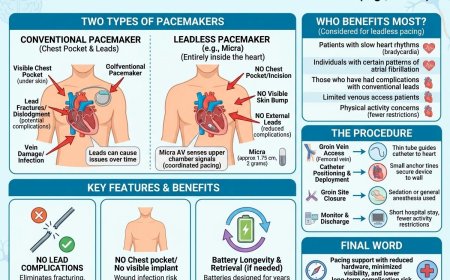
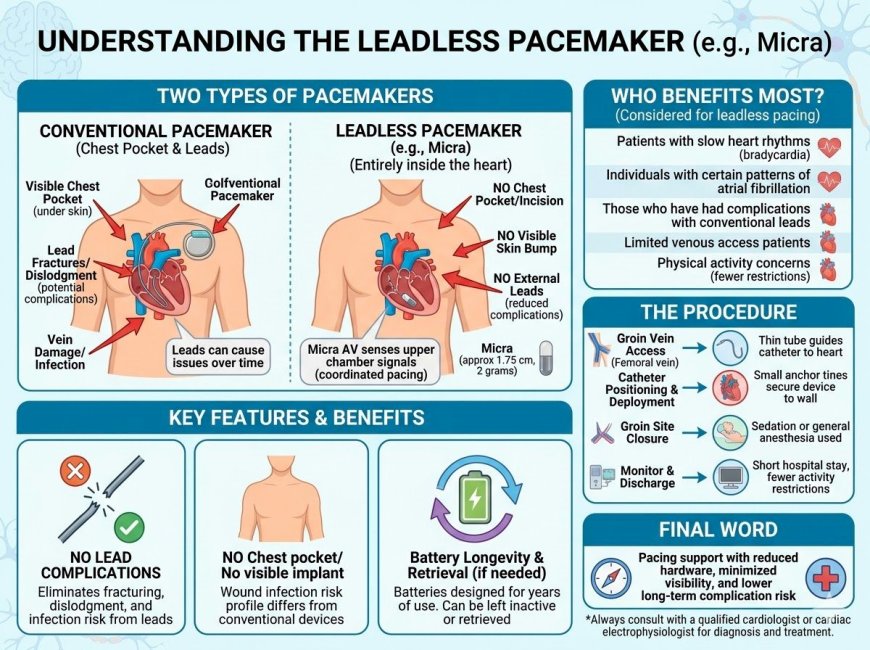
A conventional pacemaker has two main components: a pulse generator (the device itself, implanted in a small pocket created under the skin near the collarbone) and one or more leads — flexible, insulated wires that travel through a vein into the heart's chambers to deliver electrical impulses.
A leadless pacemaker removes both of those components from outside the heart entirely. Instead, the entire device — generator and electrode combined — is implanted directly inside the heart itself.
The Micra Transcatheter Pacing System, developed by Medtronic, is the most widely used leadless pacemaker in clinical practice. It is approximately 1.75 centimetres in length — roughly the size of a large capsule — and weighs about 2 grams. It attaches to the inner wall of the right ventricle (the lower-right chamber of the heart) using small tines, similar in principle to a tiny anchor, and delivers pacing impulses directly from within the heart tissue.
There are currently two versions in clinical use: the original Micra AV, designed for single-chamber pacing, and the Micra AV, which also senses mechanical activity in the upper chambers of the heart to help coordinate pacing between chambers — a meaningful advancement for patients who need more physiologically coordinated stimulation.
How Does a Conventional Pacemaker Work — and Why Do Leads Sometimes Become a Problem?
To appreciate the significance of the leadless design, it helps to understand what leads do and why they can, over time, create complications.
The heart runs on electrical signals. In a healthy heart, a natural "spark" originates in a cluster of cells called the sinoatrial node and travels through a precise conduction pathway, triggering the chambers to contract in coordinated sequence. When this electrical system is disrupted — whether by disease, ageing, or other factors — the heart may beat too slowly, too irregularly, or with poor coordination between chambers.
A pacemaker's job is to monitor that electrical activity and step in when needed, delivering a precisely timed electrical impulse to prompt a heartbeat.
In a conventional pacemaker, leads are the essential bridge between device and heart. But leads are also the component most associated with long-term complications. Over years, they can fracture, become dislodged, cause infections at the implant site, or be damaged during future cardiac procedures. In patients who may need the device for many years, lead management becomes a genuine clinical consideration.
The leadless design removes this variable entirely.
Who Is Typically Considered for a Leadless Pacemaker?
Not every patient who needs a pacemaker is a candidate for the leadless approach — at least not in every clinical situation. The determination is always made by a cardiologist based on the individual patient's cardiac anatomy, the nature of the electrical problem, and other health factors.
That said, patients who are typically considered for leadless pacing include:
- Those with slow heart rhythms — a condition called bradycardia — where the heart beats too infrequently to sustain adequate blood flow
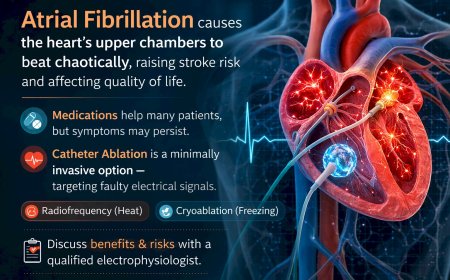
- Patients in certain patterns of atrial fibrillation (an irregular heart rhythm originating in the upper chambers) combined with a slow ventricular rate
- Individuals who have had complications with conventional lead systems in the past, such as lead infections or fractures
- Patients with limited venous access, making conventional lead placement difficult or risky
- Patients who have a high bleeding risk or other factors that make a chest pocket implant less desirable
- In some cases, patients who are physically active and concerned about lead-related restrictions
Your cardiologist will discuss whether the leadless approach is appropriate for your specific cardiac situation. Not all forms of heart rhythm disturbance can currently be managed with leadless pacing alone — some patients require multi-lead systems for more complex coordination between chambers.
The Procedure — What Happens, General Benefits, and Risks
How the procedure is performed
The Micra device is delivered through a catheter — a thin, flexible tube — that is inserted through a vein in the groin (the femoral vein) and guided up into the right side of the heart. No surgical incision in the chest is required. Once the cardiologist positions the catheter in the appropriate location within the right ventricle, the device is deployed and its small anchor tines secure it to the heart wall.
The procedure is typically performed under sedation or general anaesthesia, and most patients are monitored for a period afterward before discharge. There is no wound near the collarbone, no visible lump beneath the skin, and no lead running through the venous system.
General benefits associated with the leadless approach
- No leads and no chest pocket: The two structures most associated with conventional pacemaker complications are eliminated
- No visible device implant site: Nothing is felt or seen beneath the skin of the chest
- Lower risk of certain infections: Without a subcutaneous pocket, the wound infection risk profile is different from that of conventional devices
- MRI compatibility: The Micra device has been designed with MRI compatibility in mind, an important consideration for patients who may need imaging over the years ahead
- Battery longevity: The Micra device is designed with battery life comparable to conventional systems, and when the battery is depleted, the device can be left in place (inactive) and a new one implanted if needed
- Reduced activity restrictions: Many patients find recovery involves fewer physical restrictions compared to conventional surgery
General risks and considerations
As with any procedure involving the heart, the leadless approach carries risks, including:
- Cardiac perforation: The catheter or the tines could, in rare instances, puncture the heart wall — a known, serious but uncommon complication associated with device deployment
- Device dislodgement: Rarely, the device may not anchor securely and could migrate
- Vascular complications at the groin insertion site
- Pacing threshold changes over time, requiring monitoring
- Limited "upgradeability": If a patient's condition progresses and they require a more complex pacing system (such as biventricular pacing for heart failure), transitioning from a leadless system adds complexity
Your cardiologist will review these risks against your individual health profile and the risks of alternative approaches.
Questions to Ask Your Cardiologist
If you have been told you may need a pacemaker, or that a leadless device may be an option, consider asking:
- Why do I need a pacemaker? What is the specific electrical problem in my heart?
- Am I a candidate for a leadless device? What factors make me a good — or less ideal — candidate?
- What happens if my heart condition changes in the future? Can a leadless pacemaker be upgraded or supplemented?
- How long will the battery last, and what happens when it does?
- Will I be able to have MRI scans with this device?
- What are the most common complications associated with this particular device in patients like me?
- How many of these procedures has your team performed?
- What will my life look like after the procedure? Activity, travel, electromagnetic devices?
These questions will help you understand not just the procedure, but the long-term management of your care.
Common Misconceptions About Leadless Pacemakers
"It's experimental." The Micra device received FDA approval in the United States and CE marking in Europe. It has been implanted in hundreds of thousands of patients globally. It is not experimental — it is an established, clinically evaluated technology.
"Removing it would be impossible." While the device is designed to remain permanently in place, retrieval has been performed in clinical settings when necessary, particularly within a defined window following implant. Your cardiologist can explain what your options would be.
"It can only pace one chamber." Earlier versions of the Micra were single-chamber devices. The Micra AV system introduced the ability to sense atrial mechanical activity and coordinate ventricular pacing accordingly — expanding the range of patients who may benefit.
"A smaller device means less effective pacing." Size does not determine pacing effectiveness. The Micra delivers the same fundamental electrical stimulation that conventional pacemakers do — the difference is only in how and where it is delivered.
"I'll set off metal detectors." Patients with any cardiac device — conventional or leadless — are advised to inform security personnel at airports and other facilities. Most modern security systems do not affect properly functioning pacemakers, but the interaction should not be assumed without guidance from your cardiologist.
Professional Support
If your doctor has recommended a pacemaker, or you want to understand whether a leadless device may be right for your situation, our specialists can answer your individual questions.
👉 https://myamericandoctor.com/our-doctors/
You may also choose to enroll in our upcoming concierge medical clinic in India, Global Concierge Doctors. We offer U.S.-style primary care with 24/7 access to India-based physicians. When required, we coordinate referrals to trusted cardiac specialists in India and the U.S.
The Final Word
A pacemaker recommendation does not mean your life becomes smaller. For most patients, it means the opposite — the heart gets the support it needs to keep up with your life.
The leadless approach is one of the more meaningful advances in cardiac device medicine in recent years: less invasive, fewer long-term complications associated with hardware, and a recovery that is less disruptive than what previous generations of patients experienced. It is not the right choice for everyone — but for the patients it suits, it represents a genuine improvement in how pacing therapy is delivered.
Ask the questions. Get the conversation started. And if you want a second opinion from a U.S.-trained cardiologist before you decide, that option is available to you.
Reader Poll
Has your doctor ever discussed pacemaker therapy with you?
- Yes, and I already have one
- Yes, it was mentioned as a possibility
- No, but I'm researching it
- I'm here for someone I care for
Share this article with someone navigating a cardiac device decision.
Medical Disclaimer
This article is intended for general patient education and informational purposes only. It does not constitute medical advice and should not be used to diagnose any condition or make any treatment decisions. References to pacemakers, the Micra device, cardiac procedures, or any cardiac intervention are for informational purposes only and do not represent a recommendation for or against any specific test, device, or procedure for any individual reader.
Every patient's cardiac situation is unique. Treatment decisions — including whether a leadless or conventional pacemaker is appropriate — must be made by a qualified cardiologist in consultation with the individual patient, based on their complete medical history, diagnostic findings, and clinical circumstances.
Not a Substitute for Professional Medical Advice: Always consult a qualified healthcare provider with any questions you may have regarding a medical condition or treatment plan. Never disregard or delay seeking professional medical advice because of something you have read here.
Not a Recommendation for Specific Tests or Treatments: This content does not recommend specific cardiac diagnostics, devices, medications, or procedures for any reader.
Accuracy and Timeliness: Medical knowledge evolves. While this article has been prepared with care, cardiac device guidelines, technology, and clinical practice may change. Verify information with your cardiologist.
AI-Assisted Content Disclosure: This article was prepared with AI assistance and reviewed for editorial alignment with MyAmericanDoctor.com's clinical guidelines.
Sources Consulted
- Medtronic. Micra Transcatheter Pacing System — Clinical Overview. Medtronic, Inc.
- Reddy VY, et al. "Permanent Leadless Cardiac Pacemaker Therapy: A Comprehensive Review." Circulation. American Heart Association.
- El-Chami MF, et al. "Leadless Pacemaker Implant in Patients With Prior Cardiac Device Infection: Updated Analysis." Journal of Cardiovascular Electrophysiology.
- Knops RE, et al. "Subcutaneous or Transvenous Defibrillator Therapy." New England Journal of Medicine.
- U.S. Food and Drug Administration. FDA Approval Summary: Micra Transcatheter Pacing System. FDA.gov.
- Duray GZ, et al. "Long-term device performance and clinical outcomes with the intracardiac leadless pacemaker." Heart Rhythm Journal.
- American Heart Association. Pacemakers — Patient Information Resources. heart.org.
What's Your Reaction?
 Like
0
Like
0
 Dislike
0
Dislike
0
 Love
0
Love
0
 Funny
0
Funny
0
 Angry
0
Angry
0
 Sad
0
Sad
0
 Wow
0
Wow
0