
"I'm Fine" - The Two Words That Kill More Hearts Than Cholesterol
Think your high blood pressure isn't serious because you feel fine? Read this wake-up call before it's too late. Learn why denial is more dangerous than the disease itself.

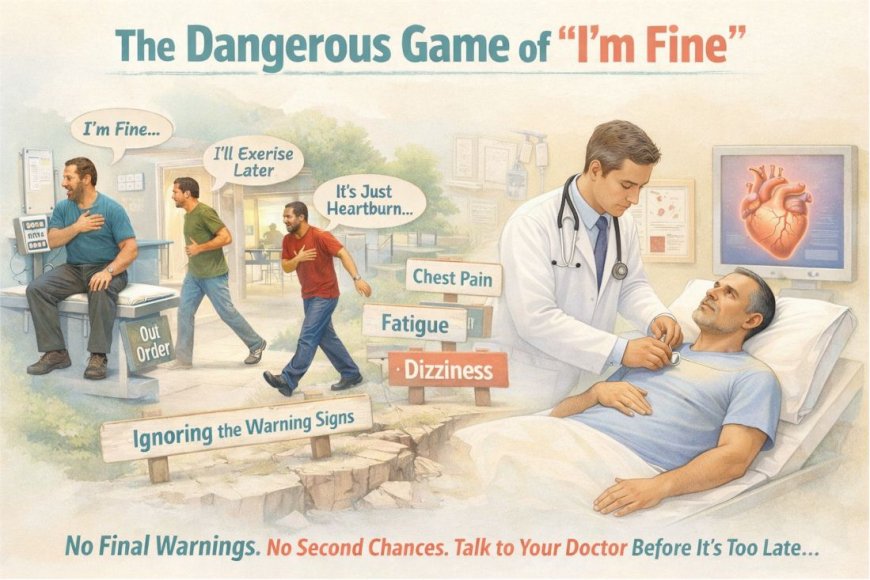
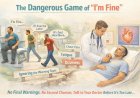
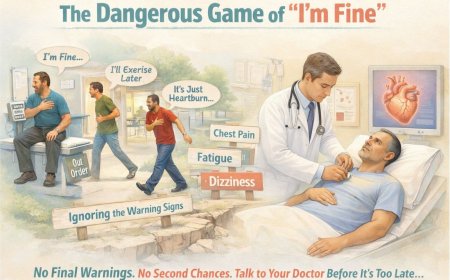
The Dangerous Game of "I'm Fine"
You felt that twinge in your chest last week. Brushed it off as gas
Your blood pressure reading was 150/95 at the pharmacy? "The machine must be broken."
Climbing stairs leaves you breathless? "I'm just out of shape."
Sound familiar?
Here's the uncomfortable truth: Your heart doesn't send registered mail before it gives up.
The Silent Rebellion Inside Your Chest
Right now, as you read this, millions of Indians are walking around with ticking time bombs in their chests. Not because they don't know about heart disease - everyone knows about it.
They're dangerous because they've mastered the art of denial.
"My father lived to 80 with high BP."
"I'll start taking it seriously next month."
"Heart attacks happen to other people."
Until one morning, YOU become that 'other person.'
What Your Body Is Screaming (But You're Not Hearing)
Let me paint you a picture of what's happening inside right now if you're ignoring high blood pressure:
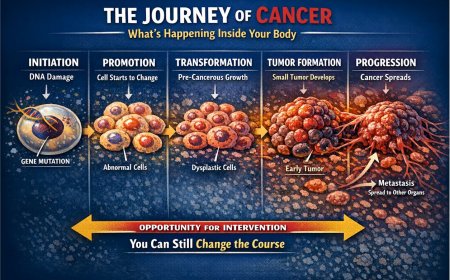
Year 1-2: The False Peace
Your arteries are like garden hoses - flexible, strong. High pressure? They cope. You feel nothing. Everything seems normal.
Year 3-5: The Silent Damage Begins
The constant pressure creates tiny tears in your artery walls. Your body patches them with cholesterol - like using duct tape on a leaking pipe. Still no symptoms. You're convinced you're fine.
Year 5-10: The Point of No Return
Those patches become plaques. Your "garden hose" is now a rigid pipe with narrowing passages. Your heart pumps harder just to do the same job. It's exhausting itself. You might feel tired but blame it on work stress, age, or lack of sleep.
Year 10+: The Catastrophe
One plaque ruptures. A clot forms. Blood supply cuts off instantly.
If it happens in your heart: Massive heart attack
If it happens in your brain: Stroke, possibly paralysis
If it happens in your kidneys: Kidney failure, hello dialysis
If it happens in your eyes: Permanent vision loss
If it happens in your legs: Possible amputation
The terrifying part?
You might only get symptoms in Year 10. By then, the damage is irreversible.
The "I Feel Fine" Trap: Why You're Dangerously Confident
Here's why you're so confident nothing will happen:
High blood pressure is called the "silent killer" for a reason.
It doesn't hurt. There's no rash. No fever. No dramatic symptoms. Your body is incredibly good at compensating... until suddenly, catastrophically, it can't.
A Real Story That Should Shake You
Rajesh, 52, Delhi businessman.
Blood pressure hovering around 160/100 for 5 years. Refused medications. "I feel absolutely fine!" he would tell his worried wife. Never missed a day of work. Played with his grandchildren every weekend.
Last month, he collapsed during a board meeting.
Massive stroke.
Right side completely paralyzed. Can't speak properly. Can't work. Can't even go to the bathroom alone. His 28-year-old son now manages the business. His wife has become a full-time caregiver.
His last words before the stroke?
"I'm perfectly healthy. Stop worrying about nothing."
The Mathematics of Denial: Numbers Don't Lie
Let me show you the numbers that should genuinely scare you:
- Normal BP: 120/80 - Your heart works at optimal efficiency
- Your BP at 140/90 - Your heart works harder EVERY SINGLE BEAT
Think about that for a moment.
Your heart is a muscle. How long can ANY muscle work much harder than it's designed to, day after day, year after year, before it simply gives up?
Your heart attack isn't coming "if" - the only question is "when."
The Three Deadly Lies You Tell Yourself
Lie #1: "I'll know when it's serious"
The Brutal Truth: 25% of heart attacks have NO warning symptoms whatsoever. The very first symptom is death. No chest pain. No warning signs. Just... gone.
For many people, sudden cardiac death is the first and last symptom of their heart disease.
Lie #2: "I'm too young for this"
The Brutal Truth: Indians develop heart disease 10 years earlier than Westerners due to genetic factors, dietary habits, and lifestyle. Cardiologists are now routinely seeing heart attacks in men in their early 30s.
Age is NOT protection. Youth is NOT immunity.
Lie #3: "My body will warn me in time to get help"
The Brutal Truth: By the time you experience chest pain, your coronary arteries are already 70-90% blocked.
Would you wait until your car has no brakes left before taking it for servicing? Then why are you doing exactly that with your heart?
What Actually Happens During a Heart Attack (The Reality No One Talks About)
Since you think "it won't happen to me," let me describe in vivid detail what your "minor BP issue" can lead to:
3:00 AM: Crushing chest pain jolts you awake. Feels like an elephant sitting on your chest. You can't breathe properly.
3:05 AM: Profuse sweating. Nausea. Vomiting. Pain radiating to your jaw and left arm. You're terrified. Your wife is screaming. Your children come running.
3:10 AM: Ambulance arrives. Sirens wailing through your neighborhood. Neighbors watching. Your family crying. Your young daughter asking "Is Papa going to die?"
3:30 AM: Emergency room. Bright lights. Needles everywhere. Monitors beeping. Strangers cutting your clothes off. People shouting medical terms you don't understand.
4:00 AM: If you're lucky, they save you with emergency angioplasty. If you're not lucky... your family starts planning your funeral while you're still warm.
If You Survive, Here's Your New Life:
- 6-8 weeks of recovery (if you're lucky)
- Lifetime of multiple medications, taken religiously
- Constant fear of another attack - every chest pain brings panic
- Severe restrictions on everything you enjoy eating
- Can't lift heavy things. Can't exert yourself. Can't live freely.
- Medical bills of ₹5-10 lakhs or more
- Emotional trauma for your entire family that never fully heals
- Your children grow up with the fear of losing you
All of this because you thought "I'm fine."
The Brutal Truth About Stroke: A Fate Worse Than Death
Think a heart attack is the worst that can happen? Let me tell you about strokes.
The Statistics of stroke in India:
- 13-42% of patients die in 30 days
- 40% are left with at least moderate disability
- Only 10-25% recover with none or some loss of function
What "permanently disabled" actually means:
Your mind is completely alert. You can think, feel, understand everything. But your body won't obey.
You can't:
- Walk to the bathroom (adult diapers for life)
- Feed yourself (someone spoon-feeds you like a baby)
- Speak clearly (you know what you want to say but it comes out garbled)
- Move half your body (it's just... dead weight)
- Work, earn, or contribute (financial burden on family)
- Live independently ever again
You become completely dependent on others for EVERYTHING. Your spouse gives up their life to care for you. Your children's future changes because they're financing your care.
And high blood pressure is the NUMBER ONE cause of stroke in India.
Why Your Brain Won't Let You Take This Seriously (The Psychology of Denial)
There are actual psychological reasons why you're in denial:
1. Optimism Bias
Your brain is hardwired to think "Bad things happen to others, not me." It's a survival mechanism gone wrong in modern times.
2. Present Bias
Today's comfort and convenience will always feel more important than tomorrow's potential health crisis. This is why people smoke despite knowing the consequences.
3. Invisibility of Damage
If you can't see it, your brain assumes it's not there. High BP does invisible damage for years before showing symptoms.
4. Fear Avoidance
You're actually too scared to face the reality, so your mind protects you by creating denial. "If I don't think about it, it's not real."
But here's the thing:
Denial doesn't prevent heart attacks or strokes. It just guarantees you won't be prepared when catastrophe strikes.
The Five Questions That Should Keep You Up Tonight
Ask yourself these questions with complete honesty:
1. If you collapsed tomorrow, is your family financially protected?
Have you calculated how they'll manage without your income? Medical bills plus lost income can bankrupt families.
2. Have you told your children everything you want them to know?
All the life lessons, values, stories, advice - have you shared it? Or are you assuming you'll have time "later"?
3. Are you ready to possibly never work again?
Your career, your identity, your purpose - ready to lose it all at 45 or 50?
4. Can you live with the regret of "I should have listened"?
That moment of realization in the ambulance - "Why didn't I take this seriously?" - can you face that?
5. Do you want your last thought to be "Why was I so stupid?"
Because that's what many heart attack victims report thinking in those final moments.
The Choice (And Make No Mistake - It IS a Choice)
Every single day you wake up, you're making a choice. You have two clear paths in front of you:
Path A: Continue the Denial
- Feel "fine" today, tomorrow, maybe for years
- Ignore the BP readings or skip checking altogether
- Skip medications or take them irregularly
- Avoid doctors and annual check-ups
- Roll the dice every single day with your life
- Hope you're one of the "lucky ones"
- Risk absolutely everything on that hope
- Leave your family's future to chance
This path feels easier. It requires no effort today. But the price you pay later is catastrophic.
Path B: Wake Up RIGHT NOW
- Accept the reality of your condition
- Take medications regularly, set phone reminders
- Limit adding salt to your food
- Monitor BP daily, maintain a log
- Schedule and keep cardiologist appointments
- Make genuine lifestyle changes
- Add 10-20 healthy, active years to your life
- Be there for your children's weddings
- Play with your grandchildren
- Watch your family grow and thrive
- Retire peacefully and travel
- Live without constant fear
This path requires effort today. But it gives you tomorrow, and the day after, and thousands more days.
Which path are you choosing RIGHT NOW by reading this article and planning to do nothing?
Your Heart's Warning Signs (Are You Ignoring These?)
Your body has actually been trying to warn you. You've just been dismissing the signals:
- Breathlessness while climbing stairs (told yourself you're out of shape)
- Unusual fatigue (thought it was just age or work pressure)
- That vague feeling that something's "off" (convinced yourself you're imagining it)
- Palpitations (said it was too much coffee)
- Chest discomfort (called it acidity or gas)
- Swelling in legs
These aren't minor inconveniences. They're your heart's SOS signals.
Ignoring them is like ignoring smoke alarms in your house because you don't see actual flames yet. By the time you see the fire, your house is burning down.
What You MUST Do Today (Not Tomorrow, Not Next Week - TODAY)
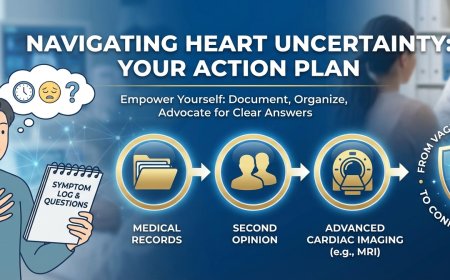
Stop reading. Take action right now. Here's your immediate action plan:
1. Check Your Blood Pressure RIGHT NOW
- Use a home BP monitor if you have one
- Write down the reading with date and time
- If it's above 130/80, you have a problem
2. Book a Cardiologist Appointment THIS WEEK
- Not next month when you're "free"
- Not after the festival season
- Not after your project deadline
- THIS WEEK
3. Follow recommendations from the cardiologist that may include:
- ECG (Electrocardiogram) - checks heart rhythm and damage
- 2D Echo - visualizes heart function
- Stress Test
- Coronary calcium score scan - Assess plaque burden
- CT or Invasive Coronary Angiogram - Visualizes coronary arteries
- Lipid Profile - checks cholesterol levels
- Fasting Blood Sugar & Hemoglobin A1c - rules out diabetes
- Kidney Function Tests - checks for BP-related damage
4. If Prescribed Medication, Start It TODAY
- No "I'll try natural methods first" excuses
- No "Let me research alternatives" delays
- Your cardiologist studied for 10+ years. Trust them.
5. Tell Someone Close About Your Condition
- Your spouse, sibling, or close friend
- Accountability matters
- They can help monitor and remind you
- They need to know in case of emergency
The Financial Reality Check
Let's talk money, because that motivates many people more than health warnings:
Cost of Prevention (Annual):
- Regular medications: ₹5,000 - 15,000
- Quarterly check-ups: ₹5,000 - 10,000
- Annual tests: ₹8,000 - 15,000
- Total: ₹18,000 - 40,000 per year
Cost of One Heart Attack:
- Emergency treatment & angioplasty: ₹3,00,000 - 8,00,000
- ICU stay (5-7 days): ₹1,50,000 - 3,00,000
- Follow-up procedures: ₹1,00,000 - 2,00,000
- Medications (lifetime): ₹20,000 - 50,000 per year
- Lost income during recovery: ₹2,00,000 - 10,00,000+
- Total: ₹7,00,000 - 23,00,000 or MORE
Plus: Emotional trauma (priceless), reduced quality of life (priceless), constant fear (priceless).
Which is the smarter financial decision?
The Uncomfortable Truth About "Natural Remedies"
I know what you're thinking: "I'll control it naturally with diet and exercise, no medications."
Here's the reality:
Yes, lifestyle changes are crucial. They can reduce BP by 10-20 points in mild cases.
But if your BP is already 150/95 or higher, lifestyle changes alone won't be enough. This is not opinion - this is medical fact backed by decades of research.
Refusing medications when you need them is like:
- Refusing antibiotics for pneumonia because you prefer "natural immunity"
- Refusing insulin for diabetes because you want to "heal naturally"
- Refusing to wear seatbelts because you're a "careful driver"
Pride and stubbornness kill more people than the diseases themselves.
Your cardiologist isn't prescribing medications to make money (they already have plenty of patients). They're prescribing them because WITHOUT them, you WILL have a heart attack or stroke. It's not "if" - it's "when."
What Happens If You Close This Tab and Do Nothing?
Let me be very direct about what will happen:
In 2 weeks: You'll have completely forgotten this article. Back to normal denial.
In 6 months: Maybe another dizzy spell. You'll ignore it again.
In 2 years: Your BP is now consistently 160/100. Still no severe symptoms. Still ignoring it.
In 5 years: Your first cardiac event. Maybe you survive. Maybe you don't.
Or: You take action today. You're alive, healthy, and active in 5 years, reading another article and thinking "Thank God I listened back then."
The choice is genuinely yours. But the consequences aren't negotiable.
The Final Word: Your Heart's Message to You
If your heart could speak, here's what it would say:
"I've been beating for you since before you were born. I've pumped 2.5 billion times in your life so far without ever taking a vacation. I've worked through every stress, every illness, every challenge you've faced.
But I'm tired now. You're making me work too hard with this high pressure. I'm developing damage. I'm wearing out faster than I should.
I've tried to warn you with subtle signals. You ignored them.
Please. I'm begging you. Help me. Take the medication. See the doctor. Make the changes.
Because once I stop, I don't start again. And I don't want to leave you yet. We have so much more life to live together.
Please listen this time. It might be the last time I can ask."
Your Next Step
You've read this entire article.
That means somewhere inside, you know I'm right. You know you're in denial. You know you need to take action.
The question is: Will you?
Or will you close this tab, go about your day, and continue the denial?
Five years from now, you'll either be:
A) Grateful you read this and took action today, living a healthy, active life with your loved ones, watching your children grow, enjoying your grandchildren, traveling, working, living fully.
OR
B) Severely disabled, dependent on others for basic tasks, filled with regret, or worse - your family will be visiting your grave, saying "If only he had listened..."
Your heart doesn't care about your excuses. It doesn't negotiate. It only cares about blood pressure, cholesterol, and proper circulation.
The scariest part?
After you finish reading this, you'll probably go back to "I'm fine." You'll find reasons to delay action. You'll convince yourself you're the exception.
Please. Don't.
Take Action Now
Step 1: Screenshot this article or bookmark it
Step 2: Check your BP today and everyday
Step 3: Share this with someone you love who's also in denial
Step 4: If you have concerns or need clarity, don’t delay—speak to a qualified doctor today
Assess your cardiac risk and establish a personalized prevention plan with a U.S.-based heart specialist. Click here to book an online second opinion with MyAmerican Doctor:
👉 https://myamericandoctor.com/our-doctors/
You can also enroll in our soon-to-be-launched concierge medical clinic in India, Global Concierge Doctors, which aims to provide US-style primary care services to patients in India.
Your health decisions today shape your life tomorrow.
Take that step now.
Your life is literally in your hands right now.
Reader Poll
Have you checked your blood pressure in the last month?
- Yes, and it's normal
- Yes, and it's high (but I'm not doing anything about it)
- No, I haven't checked
- I don't even know what my numbers are
Drop your answer in the comments. Let's create accountability together.
Share This Article
Know someone who's ignoring their high BP or heart disease risk? Someone who keeps saying "I'm fine" despite warning signs?
Share this article with them. It might save their life.
Use the share buttons below or send them the direct link. Sometimes, a wake-up call from an outside source hits harder than family nagging.
Disclaimer
This article is for educational and awareness purposes. It is not a substitute for professional medical advice. If you have high blood pressure or heart disease concerns, please consult a qualified medical practitioner immediately. Every person's medical situation is unique and requires personalized professional care.
What's your BP right now? Do you even know?
That's the problem.
And that could be your last mistake.
Written with the hope of saving lives. Share it forward.
Related Articles You Should Read:
- Understanding Your Blood Pressure Numbers: A Complete Guide
- 10 Heart Attack Symptoms Women Often Ignore
- How to Choose the Right Cardiologist
- Cardiac Rehabilitation: Life After a Heart Attack
What's Your Reaction?
 Like
0
Like
0
 Dislike
0
Dislike
0
 Love
0
Love
0
 Funny
0
Funny
0
 Angry
0
Angry
0
 Sad
0
Sad
0
 Wow
0
Wow
0